
Feast or Famine: Julia's glorious fun outweighs Julie's lack of charm
[Movie review: Julie & Julia]
Mick Jagger. Sir Winston Churchill. Hervé “Tattoo” Villechaize ** **(“Da plane, boss. Da plane!”)
These are just a few people I am convinced that Oscar-winning actress Meryl Streep could no doubt play with both an uncanny accuracy and a great deal of fun.
She certainly gathers all the right ingredients to capture the singular joie de vivre of iconic author and TV chef Julia Child. Then with a little shake and bake here, some tender loving care there and a liberal dose of buttery delight all over, she serves it all up to perfection. Streep as Julia is an absolute feast — for the eyes, the funny bone and the heart.
Unfortunately Streep’s Julia is not the only thing on this cinematic menu. The movie is, after all, based on two books — Child’s memoir My Life In France and Julie Powell’s 2005 book, Julie And Julia: My Year of Cooking Dangerously. It is an interesting idea to intertwine both books in one movie and if the idea is to use one to contrast with the other, then the idea works — just too well for its own good. After all, whatever contrasts with “delightful” — like “deadly dull” or “borrring” or “pain in the butt” — is not good news for the viewer.
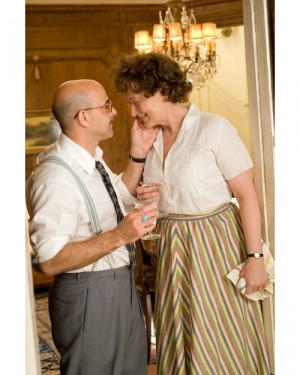
Paul (Stanley Tucci) and Julia (Meryl Streep)
Julia’s adventures in post-war Paris with her husband Paul the American diplomat are as rich and vibrant as Child’s personal outlook on life. At one point she’s openly wondering what to do with herself. Paul simply asks her what she is most good at. “Eating,” is her outrageous but accurate reply.
When the laughter has subsided. it’s not a huge jump from there to taking on the male establishment at Le Cordon Bleu school of cooking where Child’s fiercely competitive nature kicks in — to gales of laughter in the now famous onion-chopping scenes.
This in turn leads to Child collaborating with two other women to write a huge cookbook for American woman on French cooking — which eventually became the legendary Mastering The Art of French Cooking. The story turns to the huge obstacles faced in trying to get such a book published. There’s also a look at the long reach of the gathering political gloom as the McCarthy era begins to unfold back in the U.S.
All this would be great if we didn’t have to keep cutting away to get back to the more modern story of Julie, played by Amy Adams. Julie is portrayed as a rather vapid, self-centred young woman living with her husband Eric in Queens, in a tiny old apartment, above a pizza parlour. Julie is a thoroughly modern woman desperate to finally, for once in her life, actually see something through to its conclusion. The project becomes cooking all of the recipes in Mastering The Art of French Cooking in one year, and blogging about her efforts. Her eventual celebrity status has publishers falling all over themselves to publish her story as a book, and literary agents dying to be her guide to sudden fame and fortune, which certainly contrasts with Child’s experiences decades earlier.
But the contrast that really divides the two sides of the movie is the contrast between “lovable” and “not even likable.” Streep’s Julia is so lovable, I found myself constantly wanting to get back to her story. Adams’ Julie is so unpleasant, in an odd, deliberate way, that I began to resent her and her story as an unfortunate intrusion. What really threw me was how Adams, who exuded such natural charm as the princess-out-of-water in Enchanted, could play someone, in my mind at least, so utterly charmless. (I hated her character, though my wife Mariette thought she wasn’t that bad.)
On its own, I think Julie And Julia: My Year of Cooking Dangerously would have made for a rather tepid and frustrating romantic comedy. There are some funny bits, usually involving dropped pans and spilt food. And some tender bits, involving the husband feeling as if he’s losing his wife to her strange ambitions and obsessive cooking. But served as it is here, it would be a rather depressing tale over all.
As a full-length feature, Julia’s story might have proved a little thin, or short, but as the scenes we do get illustrate, it still would have been glorious fun.
I can’t blame screenwriter/director Nora Ephron for combining the two stories. It must have seemed a natural fit, with one story underlining the other. And I am well aware of the artistic adage that without dark there is no light. But I don’t need a burnt hamburger next to my filet mignon to remind me how super the filet has turned out.
A couple of special mentions: Mary Lynn Rajskub, better known as the socially awkward Chloe on the TV series 24, is quite funny as Julie’s friend Sarah. Stanley Tucci is excellent as Julia’s husband Paul. One of the more delightful aspects of that side of the movie is the wonderful, loving, even sensual relationship between Paul and Julia. After all, tall, big-boned, ungainly, and squeaky-voiced Julia is hardly anyone’s candidate for a sexual fantasy. Yet Streep makes her so real, so well rounded, so natural, that she is touchingly sensual, as well as funny and charming. And Tucci completes the picture, making them highly believable as a loving, sexually active couple.
All this and more make Paul and Julia the people you want to hang out with in this movie — and perhaps even in real life if they hadn’t been from another time period. As for Julie and her husband Eric, well let’s just say I’d rather go downstairs for pizza than eat at their apartment.
Do note, however, that no matter how dreary I found the Julie half of the film, it is still definitely worth enduring for every glorious moment we spend with Julia in her world. It’s just a bit like having to eat some despised vegetable to get to enjoy one’s rack of lamb. The latter certainly removes any bad taste from the former.
So if you are the least bit intrigued, or inclined, do not miss Streep and company in Julie & Julia. They’re a real treat. Bon appetit!
13 Comments on “Feast or Famine: Julia's glorious fun outweighs Julie's lack of charm”