Category: Movie review

TARANTINO TRULY AN INGLORIOUS BASTERD

I can’t believe I stayed up most of the night just to watch Inglorious Basterds before tonight’s Oscars. Was it a complete waste of two and a half hours? No. But close enough to make me wish I’d gone to bed instead.

I should state up front that I’m not really a Quentin Tarantino fan. His blatant fondness for not only gratuitous violence but gratuitous gore as well, strikes me as childish and immature. Frankly it turns me off.

It reminds me of my own childhood at Saturday afternoon matinées when we’d delight in groaning “ewwww” at any incidental gore — the old arrow through the eye or a simulated scalping. (Yes, we watched a lot of westerns and Robin Hood-style adventures back then.)

But even as we looked to be grossed out in battle scenes and such, we knew we were being puerile, even if we didn’t know the meaning of the word at the time.

Wallowing in excesses

It seems Tarantino never got past that stage and now that he’s writing and directing his own films, he seems to revel in his own excesses. Unfortunately, according to box office receipts, there seem to be a lot of movie goers who think he’s some kind of genius. They must share his taste for the tasteless.

Quentin Tarantino, aka Mr. Gaga

Scalpings were never realistic on film back in my childhood days. Today, special effects departments have the ability to make them utterly realistic. I’m not sure I need to see such a graphic cutting and peeling back of the scalp to reveal the bloody top of the skull once, let alone the several times Tarantino indulges himself throughout this overblown movie.

As for carving swastika’s on the foreheads of Nazi villains, the scars on the forehead of the first victim shown made the point. Having to later witness a super realistic simulation of the act itself is a perfect example of Tarantino’s wallowing in gratuitous gore.

And he certainly does wallow. In the cuttings and carvings of human flesh there is no quick cutaway so the mind can fill in its own details. No, in Tarantino’s hands, the camera lingers, almost savours the grotesqueness.

As for the man beaten to death with a baseball bat, the lead up goes on far too long. And while the actual beating seems short by comparison, it too is far too vivid and graphic and realistic to be anything but Tarantino, as usual, rubbing our noses in the excessive violence and gore.

So why this concentration on Tarantino’s fascination with — addiction to? — blood and guts? Because they are the so-called highlights of the movie.

There is a story and in more mature hands — and with a much-shorter running time — there could have been a tense and compelling drama here.

But Tarantino lingers too much. One can almost feel him savouring his own cleverness, until his dawdling undermines said cleverness.

Crying over spilt milk

The opening cat and mouse game between an SS officer and a French dairy farmer is a great example. The performance by Christoph Waltz as the German officer is fascinating. And yet the whole scene tends to slowly seep across the screen like a pool of spilt milk. To the point one starts to wonder if it will ever get to its point. Will it ever end? Or will it take up the entire two and a half hours? If so, what about the infamous scalping scenes?

Waltz is up for an Oscar as Best Supporting Actor and his performance, though at time a bit over the top, is a tour de force. Too bad it’s wasted in this tour de farce.

On the other hand, so-called lead actor Brad Pitt seems to be there just to add a big name, a familiar name, to help sell the movie. His performance is an embarrassment. As the leader of a small group of assassins behind enemy lines during World War II, Pitt’s character is played as a buffoon. Whether this is done to underline the comic-book nature of the film, or merely a disguise for Pitt to hide behind, doesn’t really matter. I almost cringed every time he appeared on screen.

There are some fine scenes involving the mostly unheralded cast — like the confrontations in the basement bar — but again Tarantino’s worst fault is his inability to rein himself in. Again the looseness and lingering, languid pace undermines the energy and strong performances, as individuals and as an ensemble.

Suddenly I feel like I’m wasting time again just writing about this film. Devoting thought and energy to a movie that really doesn’t deserve it. Nor, in my mind, does it deserve its Oscar nominations for Best Picture and Best Director.

I’m somewhat insulted by Tarantino’s pandering to the puerile child that lurks within us. And I’m no prude or goody-goody. I’d actually be a bit ashamed of myself if I did enjoy — or at least be entertained by — this gratuitous drivel. It’s fine to say it’s just a cinematic comic book by an admitted show off but beyond the indulgence in the gross-out moments, there’s really little point to this film.

To me, it’s just a sad waste of talent, celluloid (so to speak) and my time.

THE HURT LOCKER — STUNNING!

Friday night we finally got to see The Hurt Locker on the big screen — well, it’s bigger than our old TV. LOL

I really wanted to see this film at the theatre, but we haven’t been good at getting out as much as we’d like. (Well, it’s actually been me who too often, when the time came (the weekend), didn’t feel up to it.) (sigh)

Anyway, without time to write much at the moment — want to rent online/watch Inglorious Basterds* before going to bed and before tomorrow night’s Oscars — I’ll just paste some of my comments from Facebook, and add some bits as well. Sorry, in advance, for any redundancies.

(*I’d watch another Oscar contender we really wanted to see, District 9, but I wouldn’t watch it without Mariette.)

The Hurt Locker

Finally got to see The Hurt Locker on the big screen — well, it’s bigger than our old TV. LOL Powerful movie making. Emotionally stunning. Intense AND entertaining. The kind of film that stays with you and keeps you thinking and feeling about it for days after.

Best picture? Avatar — visually stunning. The Hurt Locker — emotionally stunning. I think despite its triteness of storyline, Avatar will win for providing Hollywood, and the movie-going public, the super box office smash that was much needed. But IF The Hurt Locker wins, you won’t see me complaining. (smile)

Best director? Technically, and for getting great performances out of his motion-caption actors, Avatar’s James Cameron was more like a superb, multi-tasking conductor. His ex-wife, Kathrine Bigelow, however, put together a powerhouse movie in The Hurt Locker, which is seemingly perfect in every nuance.

Jeremy Renner in The Hurt Locker

Jeremy Renner in The Hurt Locker

This film had me on the edge of my seat from the opening moment. Movies ask viewers to suspend disbelief. I HAD to “re-pend” it. It felt like the only way I could survive the opening scenes was to keep reminding myself, “It’s only a movie. It’s only a movie.”

For those who don’t know, The Hurt Locker is about American soldiers who work as a three-man bomb disposable team risking life and limb to disarm bombs — IEDs, car bombs and those strapped to suicide bombers — in Iraq. It is not only timely, but puts the viewer right there on the debris-filled streets carefully watched by poker-faced locals.  Friend or foe? Are these bystanders innocent? Or are they ready to trigger the very bomb the “invaders” are trying to defuse on the behalf of local citizens, as well as fellow soldiers?

Ultimately it’s the story of one man and why he does what he does and what I feel very few, if any of us, would have the ba … err … nerves to do. He’s played to perfection by little known Jeremy Renner. I haven’t seen enough other movies to award him a Best Actor Oscar, but if this long-shot wins, he deserves it.

(Some may remember Renner on TV as Sgt. Jason Walsh, the diner-owning policeman in last seasons much underrated The Unusuals. Walsh was the quirky veteran cop training his new partner, a refusing-to-be-spoiled rich girl played by Amber Tamblyn, previously seen as Joan in Joan of Arcadia. We loved both shows and miss them both.)

In was wondering if The Hurt Locker, currently playing in Ottawa only at Rainbow Cinemas, might be re-released in major theatres if it wins an Oscar. IF so, despite having already seen it, I’d probably like to finally see it on a true big screen.

And even if I know everything that happens, it would probably still scare the heck out of me and keep me on a mental and emotional edge all the way through.

It’s THAT powerful. It’s THAT well done.

Feast or Famine: Julia's glorious fun outweighs Julie's lack of charm

[Movie review: Julie & Julia]

Mick Jagger. Sir Winston Churchill. Hervé “Tattoo” Villechaize ** **(“Da plane, boss. Da plane!”)

These are just a few people I am convinced that Oscar-winning actress Meryl Streep could no doubt play with both an uncanny accuracy and a great deal of fun.

She certainly gathers all the right ingredients to capture the singular joie de vivre of iconic author and TV chef Julia Child. Then with a little shake and bake here, some tender loving care there and a liberal dose of buttery delight all over, she serves it all up to perfection. Streep as Julia is an absolute feast — for the eyes, the funny bone and the heart.

Unfortunately Streep’s Julia is not the only thing on this cinematic menu. The movie is, after all, based on two books — Child’s memoir My Life In France and Julie Powell’s 2005 book, Julie And Julia: My Year of Cooking Dangerously. It is an interesting idea to intertwine both books in one movie and if the idea is to use one to contrast with the other, then the idea works — just too well for its own good. After all, whatever contrasts with “delightful” — like “deadly dull” or “borrring” or “pain in the butt” — is not good news for the viewer.

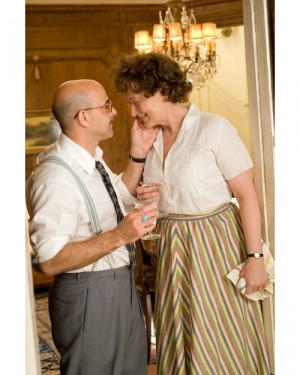
Paul (Stanley Tucci) and Julia (Meryl Streep)

Paul (Stanley Tucci) and Julia (Meryl Streep)

Julia’s adventures in post-war Paris with her husband Paul the American diplomat are as rich and vibrant as Child’s personal outlook on life. At one point she’s openly wondering what to do with herself. Paul simply asks her what she is most good at. “Eating,” is her outrageous but accurate reply.

When the laughter has subsided. it’s not a huge jump from there to taking on the male establishment at Le Cordon Bleu school of cooking where Child’s fiercely competitive nature kicks in — to gales of laughter in the now famous onion-chopping scenes.

This in turn leads to Child collaborating with two other women to write a huge cookbook for American woman on French cooking — which eventually became the legendary Mastering The Art of French Cooking. The story turns to the huge obstacles faced in trying to get such a book published. There’s also a look at the long reach of the gathering political gloom as the McCarthy era begins to unfold back in the U.S.

All this would be great if we didn’t have to keep cutting away to get back to the more modern story of Julie, played by Amy Adams. Julie is portrayed as a rather vapid, self-centred young woman living with her husband Eric in Queens, in a  tiny old apartment, above a pizza parlour. Julie is a thoroughly modern woman desperate to finally, for once in her life, actually see something through to its conclusion. The project becomes cooking all of the recipes in Mastering The Art of French Cooking in one year, and blogging about her efforts. Her eventual celebrity status has publishers falling all over themselves to publish her story as a book, and literary agents dying to be her guide to sudden fame and fortune, which certainly contrasts with Child’s experiences decades earlier.

But the contrast that really divides the two sides of the movie is the contrast between “lovable” and “not even likable.” Streep’s Julia is so lovable, I found myself constantly wanting to get back to her story. Adams’ Julie is so unpleasant, in an odd, deliberate way, that I began to resent her and her story as an unfortunate intrusion. What really threw me was how Adams, who exuded such natural charm as the princess-out-of-water in Enchanted, could play someone, in my mind at least, so utterly charmless.  (I hated her character, though my wife Mariette thought she wasn’t that bad.)

On its own, I think Julie And Julia: My Year of Cooking Dangerously would have made for a rather tepid and frustrating romantic comedy. There are some funny bits, usually involving dropped pans and spilt food. And some tender bits, involving the husband feeling as if he’s losing his wife to her strange ambitions and obsessive cooking. But served as it is here, it would be a rather depressing tale over all.

As a full-length feature, Julia’s story might have proved a little thin, or short, but as the scenes we do get illustrate, it still would have been glorious fun.

I can’t blame screenwriter/director Nora Ephron for combining the two stories. It must have seemed a natural fit, with one story underlining the other. And I am well aware of the artistic adage that without dark there is no light. But I don’t need a burnt hamburger next to my filet mignon to remind me how super the filet has turned out.

A couple of special mentions: Mary Lynn Rajskub, better known as the socially awkward Chloe on the TV series 24, is quite funny as Julie’s friend Sarah. Stanley Tucci is excellent as Julia’s husband Paul. One of the more delightful aspects of that side of the movie is the wonderful, loving, even sensual relationship between Paul and Julia. After all, tall, big-boned, ungainly, and squeaky-voiced Julia is hardly anyone’s candidate for a sexual fantasy. Yet Streep makes her so real, so well rounded, so natural, that she is touchingly sensual, as well as funny and charming. And Tucci completes the picture, making them highly believable as a loving, sexually active couple.

All this and more make Paul and Julia the people you want to hang out with in this movie — and perhaps even in real life if they hadn’t been from another time period. As for Julie and her husband Eric, well let’s just say I’d rather go downstairs for pizza than eat at their apartment.

Do note, however, that no matter how dreary I found the Julie half of the film, it is still definitely worth enduring for every glorious moment we spend with Julia in her world. It’s just a bit like having to eat some despised vegetable to get to enjoy one’s rack of lamb. The latter certainly removes any bad taste from the former.

So if you are the least bit intrigued, or inclined, do not miss Streep and company in Julie & Julia. They’re a real treat. Bon appetit!